
Rotator Cuff Injury Treatment in Caro
Conservative rotator cuff care in Caro, MI — myofascial release plus shoulder, thoracic and neck adjustments, without drugs or surgery when possible.
Chiropractic care for rotator cuff injury
Get to the root of your rotator cuff injury
Also known as: Rotator Cuff Tear, Rotator Cuff Tendinitis, Shoulder Impingement
If reaching overhead, sleeping on your side, or throwing a ball sends a sharp pain through your shoulder, your rotator cuff may be the culprit. Whether it's tendinitis from repetitive overhead work, impingement from a compressed bursa, or a partial tear from a sports collision, our chiropractor offers a conservative, drug-free plan aimed at restoring shoulder motion and easing the pain — and refers honestly when surgery is the right next step.
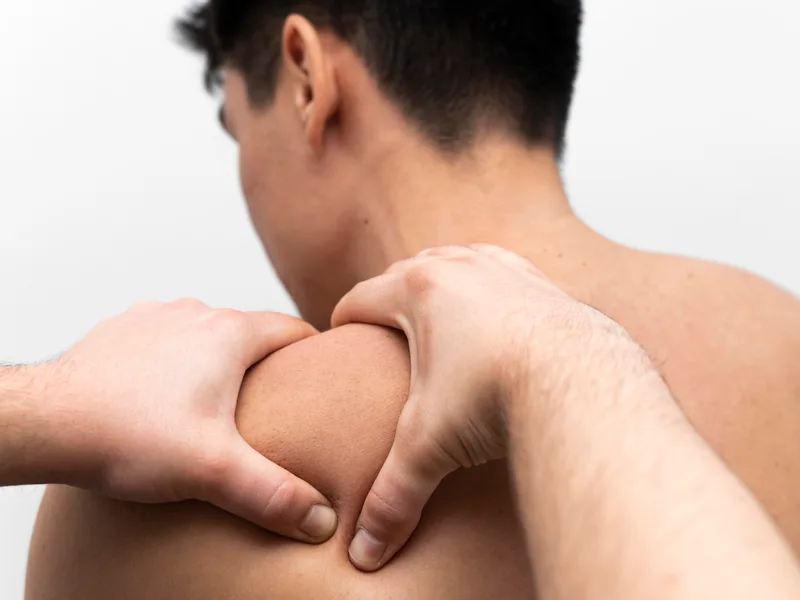
Symptoms of rotator cuff injury
- ✓A deep, dull ache in the outer shoulder or upper arm
- ✓Pain that worsens when reaching overhead or behind your back
- ✓Weakness when lifting your arm or rotating it outward
- ✓Catching, clicking, or a pinching sensation at the top of your shoulder arc
- ✓Night pain that wakes you — especially when lying on the affected side
- ✓Stiffness and limited range of motion after rest
- ✓Shoulder fatigue that limits work or sport before the arm gives out
Common causes
- Repetitive overhead work or throwing that wears the tendon over time
- Acute injury from a fall on an outstretched arm or direct shoulder impact
- Forward-shoulder posture narrowing the subacromial space
- Age-related tendon degeneration — rotator cuff tissue thins after 40
- Weakness in the rotator cuff and scapular stabilizers from disuse
- Thoracic stiffness that limits shoulder elevation mechanics
- Poor shoulder-blade control (scapular dyskinesis) during overhead movement
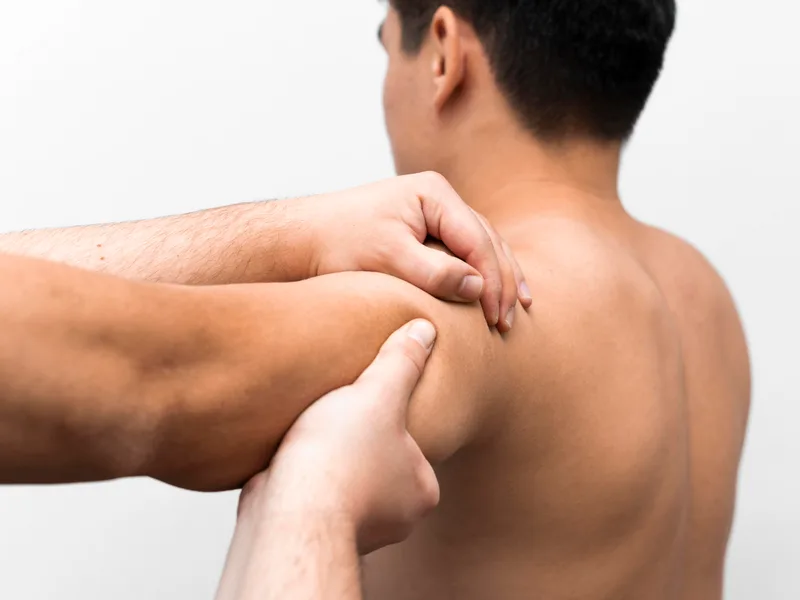
Our approach
How we treat rotator cuff injury in Caro
- Step 1
Thorough exam
We assess shoulder range of motion, rotator cuff strength, impingement tests, and cervical and thoracic mobility to map the real source of your pain — and refer for imaging (ultrasound or MRI) when it will change your care.
- Step 2
A clear, personalized plan
You leave the first visit knowing what we found, whether conservative care is the right path, and — if it is — a specific, time-bound care plan with a realistic endpoint and clear criteria for when to escalate.
- Step 3
Soft tissue, adjustments & joint mobility
We combine shoulder, thoracic, and cervical adjustments with hands-on myofascial release for the pec and lat — and the instrument-assisted Activator Method when a lighter touch is the better fit — to relieve pain now and restore the shoulder mechanics that protect the joint.
The basics
Understanding rotator cuff injury
The rotator cuff is a group of four muscles and their tendons — supraspinatus, infraspinatus, teres minor, and subscapularis — that wrap around the head of the humerus and hold it centered in the shallow socket of the shoulder blade. Every time you lift, throw, or reach overhead, those tendons glide through a narrow space beneath the acromion. When the shoulder mechanics are off — from weakness, poor posture, or repetitive strain — that space narrows further and the tendons begin to fray, inflame, or tear. Tendinitis and impingement are the earliest and most treatable stages. Partial-thickness tears often respond to conservative care and hands-on soft-tissue work. Full-thickness or massive tears may ultimately require surgical repair, and we will tell you clearly if that's where you land.
The good news is that most rotator cuff problems are at the tendinitis, impingement, or partial-tear stage — where conservative care is the usual first-line approach. Restoring joint centration through shoulder, thoracic, and cervical adjustments and releasing the tight pecs and lats that pull the shoulder forward gives the tendon room to settle and the shoulder what it needs to stay healthy. Timing matters — earlier care means less degeneration and a faster return to full use.

New Patient Special
Your first visit for just $47
Our commitment to the community is to give everybody a chance to see how chiropractic care can help them so this offer includes:
- One-on-one consultation
- Comprehensive chiropractic exam
- X-rays (if needed)
- Report of findings
- Chiropractic adjustment
- Personalized care plan recommendations
New patient offer
$47
New patients only
Claim My $47 Visit or call (989) 208-3847We are sorry, but due to regulations, this offer excludes participants of federal aid programs such as Medicare or Medicaid.
Types of rotator cuff conditions we treat
“Rotator cuff injury” covers a spectrum of presentations, and your care plan depends on which stage you’re in. We care for:
- Rotator cuff tendinitis — inflammation of one or more cuff tendons from overuse, typically the supraspinatus. Responds well to soft-tissue release, adjustments that restore shoulder and thoracic motion, and sensible load management. See our related shoulder pain page for the broader shoulder picture.
- Shoulder impingement syndrome — the tendon and bursa become pinched beneath the acromion during elevation. Often driven by forward-shoulder posture and scapular weakness — both of which we address directly.
- Subacromial bursitis — the bursa cushioning the tendon becomes inflamed and swollen, amplifying impingement pain. Conservative care and posture guidance address the mechanics that keep it irritated.
- Partial-thickness rotator cuff tear — the tendon is frayed but not fully disrupted. Conservative care is the research-supported first step here, and surgery is not the automatic next step.
- Rotator cuff weakness from overuse or disuse — the cuff muscles atrophy after injury or prolonged rest, leaving the shoulder vulnerable to re-injury. Restoring shoulder and thoracic motion through chiropractic care and athlete care is the starting point here, alongside a gradual return to the demands you put on the shoulder.
If you’ve been diagnosed with a full-thickness tear and are wondering whether surgery is avoidable, an honest exam and a supervised conservative trial will give you a real answer — not a guess. And if conservative care isn’t the right path, we’ll tell you before you invest time in it. Overhead athletes dealing with overuse injuries often present with early-stage cuff problems we can catch before they become structural.
When to see a chiropractor in Caro
Don’t wait until the shoulder is completely locked up or your arm gives out on the job. Consider booking an exam if you notice:
- Shoulder pain or weakness when lifting your arm above shoulder height
- Aching that lingers after activity or wakes you at night
- A catching or pinching sensation at the top of your shoulder arc
- Shoulder pain that followed a fall, collision, or sudden forceful pull
- Pain or tingling that travels from the shoulder into your arm or hand
- Shoulder stiffness that gets worse with rest and doesn’t loosen up with movement
- Any acute injury where you felt or heard a pop in the shoulder — seek evaluation promptly
Seek emergency care if you experience severe shoulder pain with inability to move the arm at all after a direct trauma — a significant full-thickness tear or fracture may be present.
What to expect at your first visit
Your first appointment runs about 45–60 minutes and is focused on understanding your shoulder before we treat it:
- Listen to your story — when it started, what movements provoke it, whether it’s related to a specific incident, and how it’s limiting your work, sport, or sleep.
- Examine thoroughly — rotator cuff strength and length testing, impingement provocation tests, shoulder and thoracic range of motion, and cervical screening to rule in or out a neck contribution.
- Explain what we found — in plain English, with a clear recommendation on whether conservative care is appropriate, whether imaging is needed first, and what a realistic recovery looks like.
- Start care when appropriate — soft-tissue work and a first shoulder or thoracic adjustment can begin the same day.
You’re never locked into open-ended treatment — just a specific plan with a real finish line, and honest escalation criteria if surgery needs to enter the conversation.
Drug-free rotator cuff relief — without medication or surgery
Anti-inflammatories and cortisone shots can reduce shoulder pain temporarily, but they don’t restore the shoulder mechanics or tendon strength that let you use your arm without pain. Surgery is occasionally necessary — and we will tell you when it is — but tendinitis, impingement, and partial tears are the stages where conservative care is typically the first approach tried. That means releasing the tight muscles pulling the shoulder forward and restoring joint motion in the shoulder, thoracic spine, and neck, so the tendon stops being pinched with every reach rather than continuing to fray. For Caro-area patients who want to get back to their sport, their job, or their sleep without drugs or downtime, this is the path.
Why choose Next Level Chiropractic
At Next Level Chiropractic, shoulder care starts with an exam rather than a guess — we examine thoroughly, explain clearly, and build a plan matched to your actual stage of injury. Our chiropractor combines chiropractic adjustment of the shoulder, thoracic spine, and neck with hands-on myofascial release and, for athletes and overhead workers, our athlete care approach. We also know when conservative care has reached its limit and a surgical consult is the honest next step — and we’ll coordinate that referral without hesitation.
Ready to find out what’s driving your shoulder pain? Our New Patient Special makes your first visit easy, and you can book an appointment online in under a minute.
Why choose chiropractic
Chiropractic care vs. the typical rotator cuff routine
| Comparison factor | Chiropractic Care | Pain Meds & Surgery |
|---|---|---|
| Addresses the root cause | ✓Restores shoulder and thoracic mechanics | ✕Masks pain or removes tissue |
| Drug-free & non-invasive | ✓Always | ✕Rarely |
| Risk of side effects | ✓Minimal | ✕Higher (meds, anesthesia, post-op) |
| Personalized to you | ✓Custom care plan | ✕One-size-fits-all protocol |
| Keeps the shoulder moving | ✓Mobility restored, not just pain masked | ✕Seldom addressed |
| Honest referral when needed | ✓Yes — full-thickness tears referred out | ✕Surgery first, questions later |
Treatment options
Services we use to relieve rotator cuff injury
Chiropractic Care
Gentle, precise chiropractic adjustments in Caro, MI that restore motion to restricted joints and relieve back pain, neck pain, and headaches at the source.
Learn more →Myofascial Release
Myofascial release in Caro, MI — slow, sustained pressure that frees the connective tissue to ease chronic tightness, restore movement, and relieve stubborn pain.
Learn more →Activator Method Technique
Activator Method chiropractic in Caro, MI — a spring-loaded, low-force instrument adjustment for all ages. Gentle, precise, and research-supported.
Learn more →Athlete Care
Athlete care in Caro helps athletes of every level come back from strains and overuse injuries and return to play stronger, with a clear, staged plan.
Learn more →Related conditions
Other conditions we treat in Caro
What causes a rotator cuff injury?+
Most rotator cuff injuries develop from cumulative overuse — repetitive overhead lifting, throwing, or reaching that gradually wears the tendon. A single traumatic event like a fall or collision can also tear the cuff acutely. Contributing factors include forward-shoulder posture, weak scapular stabilizers, stiff thoracic spine, and the natural tendon thinning that comes with age after 40.
Can a chiropractor help a rotator cuff injury?+
Yes, for tendinitis, impingement, and partial tears — which account for the majority of rotator cuff presentations in chiropractic practice. Conservative care that restores shoulder mechanics and releases the tight surrounding muscles is well-supported by evidence. Full-thickness tears may ultimately need surgical repair, and we'll tell you honestly if that's the case after your exam.
How do I know if I have a rotator cuff tear or just tendinitis?+
Both produce shoulder pain, but tears tend to cause more weakness and a greater loss of active range of motion. Impingement tests and strength testing during your exam give us a good clinical picture. When the findings suggest a significant tear, we refer for ultrasound or MRI to confirm before committing to a care plan.
How many visits will I need?+
It depends on the stage of the injury, how long it has been there, and the demands you put on the shoulder. Our chiropractor gives you a specific plan with a clear endpoint after your exam — not open-ended treatment.
Will my insurance cover rotator cuff chiropractic care?+
Coverage varies by plan. Call our Caro office at (989) 208-3847 with your insurance details and we will help you understand your benefits before your first visit.
Is chiropractic treatment for the rotator cuff safe?+
Yes. We screen for contraindications during your exam. Adjustments to the shoulder, thoracic spine, and neck are gentle, and we match the pressure and technique to the stage of your injury — including the instrument-assisted Activator Method when that is the safer fit.
What if I need surgery — do you still refer out?+
Absolutely. Full-thickness or massive tears, or partial tears that fail to improve with a proper conservative trial, should be evaluated by an orthopedic surgeon. We coordinate that referral and document your conservative care thoroughly so the surgeon has the full picture.
Can I still exercise with a rotator cuff injury?+
Lower-body and core work that keeps the shoulder unloaded is usually fine. We talk through which movements to modify or avoid while the shoulder heals, and we reassess as you go so you are not left guessing about when it is reasonable to reach overhead again.
Do you treat rotator cuff injuries from sports?+
Yes. Rotator cuff injuries are common in overhead athletes — swimmers, pitchers, volleyball players, and CrossFit athletes — as well as in workers who lift or reach overhead all day. Athlete care is one of the services we offer, and we will be straightforward with you about what the shoulder is ready for at each stage.
Does rotator cuff injury cause neck pain too?+
It can work both directions. A stiff or restricted lower cervical spine can alter how the shoulder blade moves and increase cuff loading. Conversely, chronic shoulder guarding often tightens the upper traps and contributes to neck pain. We assess and treat both in the same plan when that overlap is present.